

By Lojeen Odeh
The work does not always begin in the lecture hall.
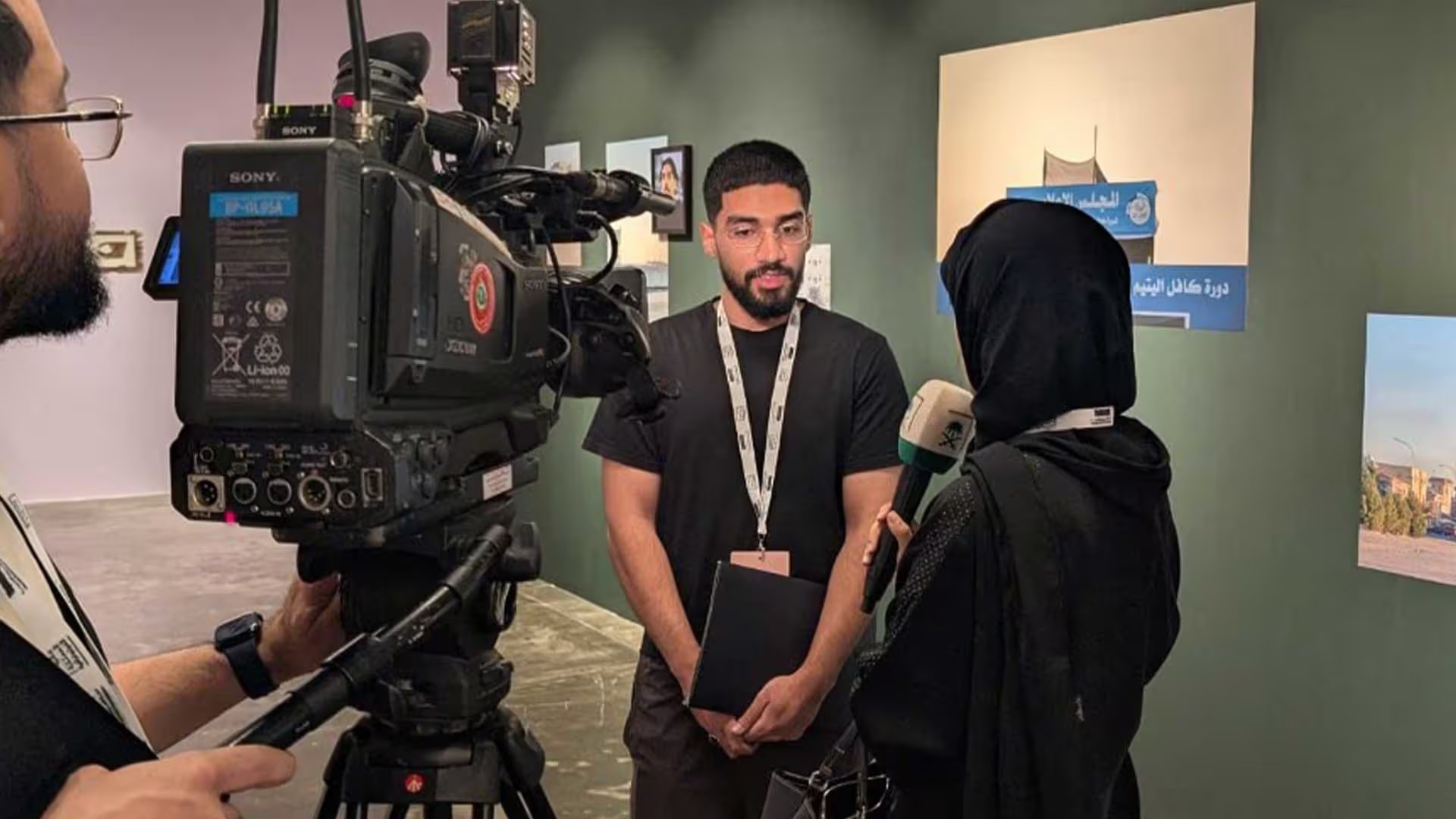
For Redha Al Hammad, it starts elsewhere. In memory, research and stories that extend beyond our campus walls. His photography is rooted in something deeply personal.
“It’s very much based in centering narratives from my hometown, Al Qatif,” he says. “There’s a lot of focus on research, oral history and collective memory.”
At the American University of Sharjah, Al Hammad is a media communications student with a concentration in integrated marketing. Off campus, he is a practicing photographer and visual artist whose work has reached galleries and audiences beyond AUS. The two identities don’t feel separate to him but rather complementary.
“I don’t look at the two as inseparable,” Al Hammad says.
Across campus, more students are beginning to balance academic life with creative, entrepreneurial or community-driven work that extends beyond their major.
This shift is increasingly visible. A 2020 study conducted at AUS by Dr. Rodrigo Basco and the Sharjah Entreurprenship Center found that while only 5% of UAE university students plan to take an entrepreneurial route immediately after graduating, that percentage rises to 41% within five years. The ambition is there, but increasingly, students are not waiting.
They are starting their careers now.
Dr. Rodrigo Basco, professor of Management and Entrepreneurship at AUS, believes universities can play a big role in how students explore external projects.
“The more supported students and graduates feel, the more confident they are to take a risk,” Dr. Basco says
Marketing student Fahad Safeer is one of them. What began as an interest in content creation turned into a functioning start-up, managing businesses’ social media accounts and running marketing campaigns.
His motivation is direct and speaks to a growing trend. “Money, the hunger for money keeps pushing me forward,” he said
Building something while studying does come with its own trade-offs. “It was very, very difficult,” he said, describing the challenge to balance coursework and clients.
He explains, “I didn’t want to let my clients down, but ultimately I knew my studies came first.”
“I never thought that I would do it as a student. Maybe in the future, yeah, but as a student I never saw it coming,” Safeer says about opening his start-up while attending university.
That pressure reflects a broader reality. Globally, the rise of the creator economy – now valued at over $100 billion, according to a recent GITNUX report – has made it easy for students to monetize their skills early. In the United Arab Emirates, government-backed initiatives are accelerating that shift. A UAE Government Youth Entrepreneurship Initiative, launched in 2025, aims to train 10,000 young entrepreneurs to create 30,000 jobs by 2030.
For some students, the process is less structured and more personal.
For media communication student, Jana Dallah, building her account without a clear plan seemed to have come organically. What began as casual posting has now grown into a large platform that has attracted the attention of students across campus and beyond.
“I just started because I love to do that,” she said. “I didn’t expect to get this much attention…people I don’t even know would come up and tell me they like my content.”
But growth came with its own set of consequences.
In her freshman year, trying to balance multiple opportunities at once, she lost her place on the Dean’s List.
“I lost by 0.2 because I got so excited at the 10,000 opportunities that I forgot I have something very important to keep, which is my scholarship.”
Now, she’s learned to approach her extra-curricular projects differently. She rejected some opportunities to ensure her academic progression is not compromised.
“I had to sacrifice some things to keep my GPA very good,” she said.
Dallah’s experiences also highlighted a common tension about the gap between what students are learning in class and what they are building on their own.
Dallah says, “I don’t think I’ve ever been taught what I do, everything I do is based on my own research.”
Not all students’ external pursuits are driven by business ventures or online visibility. For electrical engineering student, Joseph Nazy, his work lies in service.
As a scout leader, Nazy dedicates his time to mentoring younger members in his church community.
“I don’t see it as a job, I see it as returning the favor,” Nazi says.
Still, the responsibility comes with certain demands. The preparation required for scouting activities takes up a lot of time, and he admits his major can be a hindrance.
“At times, the balance becomes difficult, and what I’m doing at university can limit my passions.”
This is where the divide becomes clear.
For many students, their side pursuits offer them independence and purpose. They allow them to explore their interests beyond the structure of their degree and begin building their careers before they turn the tassel.
It does come with pressures, time constraints, academic sacrifices and, at times, a lack of institutional support.
Universities, including AUS, are beginning to respond, offering entrepreneurship programs and resources. Spaces like the Sharjah Sheraa Hub, located on campus, brings together experts from across the UAE to facilitate mentorship and offers students firsthand access to developing the soft and hard skills needed to build a business.
For many students, the learning happens in and outside the classroom, through their own trial, failure and self-direction.
Students like Redha, Jana, Fahad and Joseph, have learned to navigate both worlds and are building careers that extend beyond their university life.
University is no longer just preparation for what comes after; it is where students’ futures are already unfolding.